
Information about Light Gray color
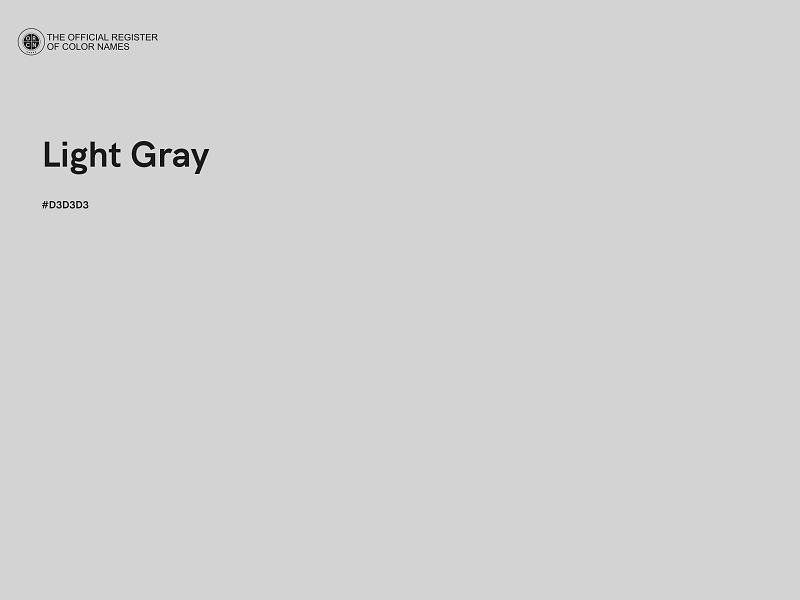
Basic facts about this digital color
#D3D3D3 is a quiet, subdued grey that appears airy and pastel-like. It is a natural fit for minimalist layouts, soft backgrounds and pastel palettes. In The Official Register of Color Names it is a hair away from Mercury (#D5D2D1). Its next-closest registered neighbors are Soft Grey (#D2D2CF) and Quarter Rakaia (#D7D6D3).
Under the hood all three RGB channels are equal (211 each), placing #D3D3D3 exactly on the neutral axis of the color space. Accessibility-wise, black text works best on #D3D3D3: 14.0:1 contrast (passing WCAG AAA) versus 1.5:1 for white. The name "Light Gray" is officially recorded for this exact shade in The Official Register of Color Names.
Light Gray color variations
View this color variations of tints, shades, tones and hues.
Light Gray color tints
Tints look brighter, pastel, and less intense.
Light Gray color shades
Shades look darker, richer, and more solid.
Light Gray color tones
Tones looks more sophisticated and complex than base colors.
Why this page shows fewer blocks
Light Gray belongs to the Greyscale Color Family, and greyscale colors have no hue. Hue is an angle on the color wheel, and that angle only exists when a color leans toward one primary more than the others. Here all three channels are equal (R = G = B), so there is nothing to lean and no angle to measure.
Everything built on rotating that angle therefore has nothing to rotate. A complementary color is the hue 180° away — for a grey, that is the same grey. The same goes for analogous, triadic, tetradic and square harmonies. Rather than show seven identical swatches, the register leaves the Hues variation strip and the whole Harmonies section out.
What remains is everything that depends on lightness rather than hue. Tints, shades and tones still work, because they move the color up and down the scale instead of around the wheel. So do the nearest named colors, the conversions and the adjacent color codes.
How the register classifies colors · All greyscale colors in the register
Alternatives to Light Gray color
View adjacent and very similar colors.
Nearest named colors to Light Gray
The closest officially registered color names in the Register, ordered by similarity.

#D5D2D1
#D2D2CF
#D7D6D3
#D6D6D6
#D3D6D8
#D1D0CE
#D2D1CD
#CDD5D5
#D9D5D1
#CED5CF
#D5D7D8
#CFCFCF
Light Gray color backgrounds & wallpapers
Download color wallpaper / background for your Desktop PC, Tablet or Mobile phone.




Conversions between color systems and etc.
- HEX#D3D3D3
- RGB211, 211, 211
- CMYK0, 0, 0, 17
- CSSrgb(211, 211, 211)
- HSL0°, 0%, 83%
- HSL Precise0°, 0%, 82.745%
- HSV0°, 0%, 83%
- HSB0°, 0%, 83%
- Normalized R (0.0–1.0)0.827
- Normalized G (0.0–1.0)0.827
- Normalized B (0.0–1.0)0.827
- GLSLvec3(0.827, 0.827, 0.827)
- GLSL with alphavec4(0.827, 0.827, 0.827, 1.000)
- HLSL / Metalfloat3(0.827, 0.827, 0.827)
- Percentage of Red in RGB82.7%
- Percentage of Green in RGB82.7%
- Percentage of Blue in RGB82.7%
- Color FamilyGreyscale
- Saturation FamilyDesaturated
- Lightness FamilyVery Light
- HEX IDD3D3D3
- DECIMAL ID13882323
- Name Length10
- This page visited63 times
- Counting from2025-01-01
